
Reviewed · PADI COURSES & CERTIFICATION
PADI Open Water Course in Cabo San Lucas
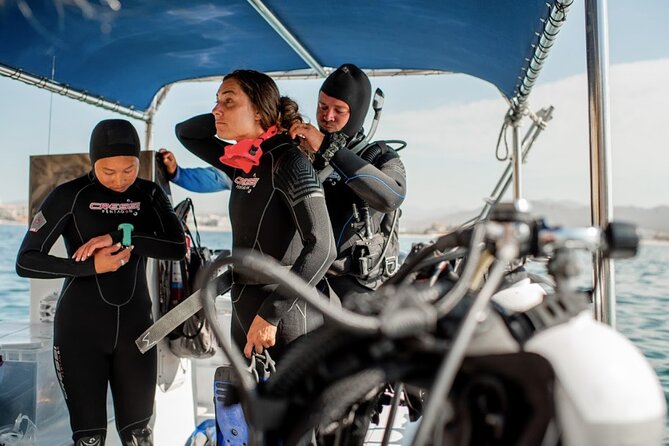
Cabo San Lucas gives this PADI Open Water course a memorable setting: the Sea of Cortez meets the Pacific beside the famous rock formations at Land’s End. You’ll learn the basics in a pool, then put them to use during four ocean sessions over two full days.
I like the small maximum of four students, which gives your instructor room to watch your technique and slow down when needed. I also like the flexible eLearning setup, since you can complete the academic work before arriving rather than spend your whole vacation in a classroom.
The main drawback is the time commitment. The online work takes about 6 to 10 hours, followed by two early starts at 8 a.m., pool training, and ocean sessions. Sea conditions can also affect the schedule, so this course needs more planning than a casual half-day activity.
Key points to know before booking
- Four ocean sessions over two days: You complete the practical certification work in the sea, not just in a pool.
- Small groups capped at four: The format allows close supervision and personal help with skills.
- 6 to 10 hours of online study: Finish the PADI eLearning before meeting your instructor.
- Pool practice comes first: You learn how equipment works and rehearse essential skills in a controlled setting.
- Instructors receive strong praise for patience: Fabien, also called Fab or Fabian, is frequently singled out, along with Joy, Johnny, Victoria, Laura, and others.
- A full certification course for $620: The price makes the most sense if you want a recognized qualification, not just a one-time underwater outing.
Cabo is a striking place to learn scuba skills. At the tip of the Baja California peninsula, the Pacific Ocean meets the Sea of Cortez, and the water around Cabo San Lucas is framed by rocky points and dramatic coastal scenery.
The course is operated by Dive Ninja Expeditions from its downtown meeting point at Ignacio Zaragoza 345, on the corner of 16 de Septiembre. The activity begins at 8 a.m. and ends back at the same location. You receive confirmation when booking, and the experience accepts mobile tickets.
This is not a quick introduction for an afternoon. It is a full PADI Open Water certification program with three connected parts: academic study, confined-water practice, and ocean training. That structure matters because you are not simply being shown how to use equipment. You are building the basic skills needed to scuba safely on future trips.
Start with PADI eLearning before Cabo
The academic portion takes about 6 to 10 hours. You can begin it at any time, but you need to finish the quizzes and exams before meeting your instructor in Cabo.
I like this setup because it gives you control over the duller part of certification. You can study at home, on the flight, or in short sessions before your holiday. It also means your two days with the instructor can focus on applying the material rather than sitting through every lesson in person.
Do not treat the online work as a box to tick without thought. You will be learning about equipment, underwater procedures, safety, and the basic principles that make scuba work. If you arrive unsure about a section, use the instructor review to ask questions before moving into the water.
The course description refers to the academic work, instructor review, equipment instruction, pool practice, and ocean sessions as one connected process. You should plan your schedule so the eLearning is complete well before the 8 a.m. meeting time.
More PADI Courses in Mexico
- Learn to Scuba Dive in Cabo San Lucas with PADI
★ 4.5 · 157 reviews - Scuba Diving with a 5-Star PADI Center in Puerto Vallarta
★ 4.5 · 135 reviews - PADI Discover Scuba Diving
★ 5.0 · 99 reviews
Day one: review, equipment, and pool skills
Your practical training begins with an instructor review. This is your chance to go back over the online material and clear up anything that did not make sense on screen.
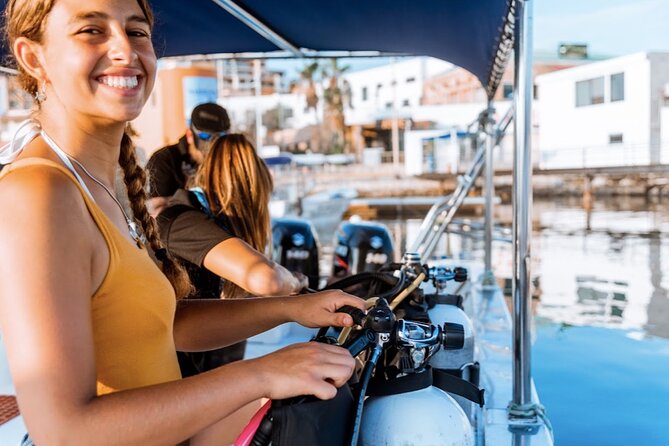
Next, you learn how the equipment works. That step is more useful than it may sound. New scuba students have a lot to take in, from assembling gear to understanding what each part does and how to respond if something feels unfamiliar underwater.
The pool session gives you a controlled place to practice. You can work through the required skills without the added challenge of ocean conditions, waves, or changing visibility. For a first-time student, this is where the course begins to feel manageable.
Your first meeting starts at 8 a.m. After the pool work, you break for lunch. The schedule then calls for two ocean sessions at about 1 p.m. The exact timing can change with conditions, but the broad pattern is clear: start with instruction and practice, then use the afternoon to begin applying those skills in the sea.
That first ocean outing can be a lot for a beginner. One student described feeling seasick and having a small panic attack on the first day, but also found the instructor patient and supportive. That is a useful warning, not a reason to avoid the course. If you are nervous, tell your instructor early and give yourself permission to slow down.
Day two: four ocean sessions bring the course together
The course uses two full days of practical training and includes four ocean sessions in total. By the second day, you have already had time to get familiar with the equipment and practice the core skills in the pool.
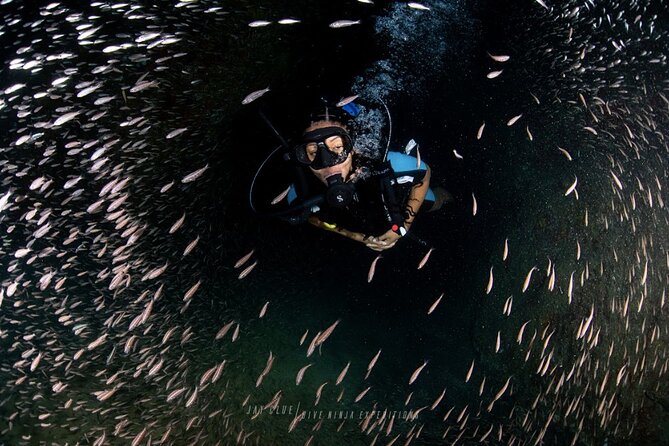
The open-water work is where the certification becomes real. You must use the techniques in an actual marine setting, while also managing your breathing, equipment, movement, and comfort. The setting around Cabo adds visual appeal, but the main value is the chance to prove that you can handle the skills outside the pool.
The schedule is fairly concentrated. You should avoid booking another demanding activity immediately afterward, especially if you are already tired from an early start and several hours in the water. The course may be listed as approximately two days and six hours, but the work is spread across two substantial training days plus the earlier eLearning.
The supplied information does not promise particular animals, reefs, or underwater landmarks. That is worth keeping in mind when you book. You are paying first for instruction and certification, with Cabo’s coastal setting as the backdrop, not for a guaranteed wildlife show.
Why the four-person limit matters
The maximum group size is four. That is one of the most useful details in the entire experience.
Scuba training requires personal attention. An instructor needs to see how you handle equipment, follow directions, control your position, and respond to basic problems. With four students or fewer, it is easier to ask questions and easier for the instructor to notice when you need another explanation.
The small format also helps if students progress at different speeds. Some people arrive eager but anxious. Others may have tried a beginner session before and feel more comfortable with the equipment. An instructor can adjust the pace more easily in a compact group than in a large class.
Several instructors are associated with the course, including Fabien, often called Fab or Fabian, as well as Joy, Johnny, Victoria, Laura, Le Roux, Marcus, and Marco. Fabien receives especially strong praise for making lessons clear, patient, friendly, and engaging. Johnny is also described as careful and easy to understand.
You cannot necessarily choose a particular instructor, so do not book solely on the hope of getting one named person. Still, the repeated emphasis on patience and safety gives you a useful expectation of the teaching style.
More PADI Courses in Cabo San Lucas
- Barcelona: PADI Discover Scuba Diving
★ 4.7 · 1,016 reviews - PADI Open Water Diver Course
★ 5.0 · 626 reviews - Tossa de Mar: PADI Discovery Scuba Diving in Costa Brava
★ 4.7 · 392 reviews - Full-Day Beginner Scuba Course with Private Tuition, Racha Yai
★ 5.0 · 368 reviews
A course that works for complete beginners and returning students
You do not need prior open-water certification. The course is designed for people who have always wanted to learn scuba, including first-time students who have never gone beyond an introductory experience.
It can also suit someone who has done a little scuba before but wants a full qualification. One student had completed introductory sessions in the past, then worked through this course with a patient instructor. Another had completed pool certification elsewhere and needed the ocean portion for the PADI qualification.
That distinction matters. If you already have pool training, ask exactly which parts of the course you need to complete and how the provider will handle your previous work. The supplied information confirms that some people use the program to complete their open-water requirements after pool training, but it does not promise the same arrangement for every booking.
The course is also a good fit for people who want to continue learning after certification. The instructors teach at different levels, and the company presents conservation as part of its wider work. If you want your first qualification to lead to more scuba education, this is a sensible place to begin that conversation.
What makes the instruction valuable
The strongest feature is the human side of the teaching. The course material can explain procedures, but it cannot calm you when you feel uneasy in the water or adapt an explanation to your learning style.
Fabien is repeatedly praised for combining enthusiasm with patience. Other instructors are described as friendly, professional, and focused on making students feel safe. One student who had a difficult first day returned for a much better second day after receiving steady support.
That is important because confidence is part of learning scuba. You do not need to arrive fearless. You do need an instructor who will treat nerves seriously, explain the next step, and avoid rushing you through a skill before you are ready.
The team also talks about marine ecosystems and conservation. That adds a useful layer to the course. You are not only learning how to operate equipment. You are also being introduced to the idea that responsible scuba means paying attention to the underwater environment and your effect on it.
The $620 price and what you receive
The listed cost is $620 per person. That is a significant expense, especially when compared with a one-time introductory scuba session, but the two experiences serve different purposes.
Here, your fee covers a structured certification path: online academic work, instructor review, equipment instruction, pool practice, and four ocean sessions over two days. You also receive the benefit of a small group capped at four people.
I would consider the price reasonable if you genuinely want a PADI Open Water qualification that you can use as the starting point for future scuba trips. It is less compelling if you only want to see what scuba feels like once. In that case, an introductory experience may be a better match, though this particular course is aimed at certification.
The value also depends on how prepared you are. Finish the eLearning before arrival, bring your questions to the instructor review, and protect the two practical days on your schedule. Arriving rushed or trying to squeeze in unrelated activities can make an already full course feel harder than it needs to be.
Timing, meeting point, and weather concerns
The meeting point is Dive Ninja Expeditions in downtown Cabo San Lucas, at Ignacio Zaragoza 345, corner of 16 de Septiembre, in the Centro area. The activity starts at 8 a.m. and returns to the same point at the end.
The location is near public transportation, which helps if you are staying in or around central Cabo. The information provided does not include hotel pickup, so you should not assume transportation from your accommodation is included. Plan how you will reach the meeting point before the first morning.
The course requires suitable weather. If poor conditions force a cancellation, you are offered another date or a full refund. That flexibility is helpful, but you should still avoid placing the course immediately before a flight or another fixed event.
You can cancel for a full refund if you do so at least 24 hours before the start time. Changes or cancellations inside that window are not accepted for a refund. The course also requires a minimum number of participants, so a cancellation for that reason results in a new date, another experience, or a full refund.
Who should book this Cabo course
You should consider it if you want to:
- Earn a widely recognized PADI Open Water qualification
- Learn in a small group rather than a large class
- Complete online study before your holiday
- Train with an instructor who can give personal attention
- Use two full days to build practical comfort
- Start a longer path of scuba education
You may want a different activity if you have only one free afternoon, dislike structured study, or want a guaranteed wildlife encounter. The course is about learning and certification first. The dramatic Cabo setting is a welcome part of it, but it does not replace the work.
It is also not ideal for a tightly packed vacation. The eLearning takes several hours, and the practical portion begins early on two days. Give yourself enough breathing room to focus.
Should you book the PADI Open Water course?
Book this course if certification is your real goal and you can give it two full practical days plus 6 to 10 hours of study. The four-person limit, patient teaching style, pool practice, and four ocean sessions create a solid path for a beginner.
I would be especially comfortable recommending it to someone who feels excited but nervous. The instructors, particularly Fabien and the wider team, are repeatedly associated with clear explanations, patience, and careful attention to safety.
Skip it if you want only a casual taste of scuba or if your Cabo schedule is too tight. For everyone else, $620 is a serious but defensible price for a complete qualification program in one of Mexico’s most memorable coastal settings.
FAQ
Where does the PADI Open Water course begin?
It begins at Dive Ninja Expeditions, Ignacio Zaragoza 345, corner of 16 de Septiembre, in downtown Cabo San Lucas, Centro, 23450, Baja California Sur, Mexico.
What time does the course start?
The stated start time is 8 a.m. on the practical training days.
How long does the full experience take?
The listed duration is approximately two days and six hours. You also need to complete the PADI eLearning, which takes about 6 to 10 hours.
How many ocean sessions are included?
The course includes four open-water sessions in the ocean, completed over two days.
Is pool training included?
Yes. You review the material with an instructor, learn how the equipment works, and practice skills in a swimming pool before completing the ocean portion.
How many people can join the course?
The activity has a maximum of four participants.
Can beginners take this course?
Yes. The PADI Open Water Diver course is designed as a starting point for scuba certification, including for people who have always wanted to learn.
What happens if bad weather cancels the course?
You are offered another date or a full refund if poor weather causes the experience to be canceled.
What is the cancellation policy?
You can cancel at least 24 hours before the start time for a full refund. Cancellations or changes made less than 24 hours before the start time are not accepted for a refund.
Newest dives added in Cabo San Lucas
- Los Cabos 2 tanks dive to The Corridor (Certified divers)★ 5.0 · 12 reviews
- Snuba Cabo San Lucas Dive Without a Tank★ 3.0 · 2 reviews
- Shark Guided Diving Los Cabos★ 5.0 · 4 reviews
- Private Beginner Scuba Diving Experience in Cabo San Lucas★ 5.0 · 25 reviews
- Whale and Dive Combo Tour in Los Cabos★ 5.0 · 3 reviews
- Los Cabos 1 tank dive to Land’s End (Certified Divers)★ 5.0 · 13 reviews
- Los Cabos Beginner Scuba Dive Experience★ 5.0 · 51 reviews
- Non-Certified Diving Adventure in Cabo San Lucas★ 4.0 · 4 reviews
PADI Courses & Certification, compared.
Tossa de Mar: PADI Discovery Scuba Diving in Costa Brava
Read our review →
Full-Day Beginner Scuba Course with Private Tuition, Racha Yai
Read our review →
Heraklion: Beginner Scuba Diving Lesson with PADI Instructor
Read our review →
Discover Scuba Diving with No Certification in St Thomas
Read our review →
Try Dive – PADI Discover Scuba Diving in Tenerife
Read our review →
Browse the lists this dive appears in