
Reviewed · DISCOVER SCUBA DIVING
Paphos: Discover Scuba Diving Half-Day Tour
Paphos puts a remarkable first scuba experience within a short walk of the town harbour. After learning the basics in a pool, you head to the Roman Wall site for a guided descent to 5 metres, where ancient amphorae, anchors, stonework, and summer sea turtles may appear below.
I like the sensible three-step format: briefing first, pool practice second, open water last. I also like the small groups, with no more than eight people and instructors such as Mick, Pavlos, Sophie, Chris, and Eva giving calm, personal help. The main catch is that you must complete the online course first, swim comfortably, and pass a medical questionnaire. This is not a casual try-it activity for non-swimmers.
Key points
- Roman harbour at 5 metres: Explore underwater remains, amphorae, anchors, and Roman walls at a beginner-friendly shore site.
- Pool practice before the sea: Learn breathing, ear equalisation, hand signals, and equipment use in controlled water.
- Small groups up to eight: Instructors can give closer attention, especially if you feel nervous.
- A patient teaching team: Mick, Pavlos, Sophie, Chris, Eva, and others have helped first-timers manage masks, breathing, and open-water nerves.
- Three hours with useful extras: Equipment, wetsuit, boots, eLearning, water, hot drinks, and fruit are included.
- Plan around flights: Wait at least 12 to 24 hours after the session before flying.
Why the Roman Wall makes a strong first scuba site
The best feature here is the setting. You are not taken far offshore for your first underwater experience. From Cydive, it is about a three-minute walk to the training site, known as the Roman Wall, making the transition from classroom to sea fairly simple.
At a maximum depth of 5 metres, the session is designed for beginners rather than certified scuba enthusiasts seeking a long excursion. You can focus on breathing steadily, clearing your ears, controlling your movement, and looking around without also dealing with a demanding descent.
The underwater sights give the lesson a real sense of purpose. The site includes ancient Roman amphorae, lost anchors, and Roman harbour remains. You may also see green sea turtles in summer, though no wildlife sighting is guaranteed. The appeal is not only the sea life. You are learning a new skill beside visible traces of Paphos’s past.
That combination matters. Pool drills can feel like schoolwork, especially when you are eager to reach the sea. Here, the reward comes quickly. Once the basic skills are complete, you can use them among historic stonework and objects that cannot be seen from the shore.
More Discover Scuba Diving in Cyprus
- Cyprus: Introductory Scuba Lesson and Dive with Transfer
★ 4.9 · 682 reviews - Half-Day Scuba Diving Tour – Discover Scuba Diving!
★ 5.0 · 669 reviews - Discover Scuba diving
★ 5.0 · 504 reviews
The first hour at Cydive: welcome, safety, and preparation
The experience begins at Cydive, near Paphos Harbour. You receive water, tea, coffee, and fresh fruit, then move into a detailed safety briefing lasting about 30 minutes. This is the part to take seriously, even if you are an experienced swimmer.
The instructor explains how to equalise the air spaces in your ears, how to use hand signals underwater, and what each skill will involve. You are also shown the equipment and told what each part does. That may sound basic, but a mask, regulator, buoyancy equipment, and air cylinder can feel like a lot when you first put everything on.
The teaching style is one of the strongest parts of this experience. Mick has been praised for clear instructions and calm support. Pavlos has helped nervous participants regain confidence before reaching open water. Sophie, Eva, Chris, and other Cydive instructors have also been singled out for patient, careful teaching.
You should expect the lesson to move at a measured pace. A first session is not about rushing through a checklist. It is about making sure you can breathe through the regulator, understand the signals, and respond to simple problems before entering the sea.
There is also time for photographs during the morning. Underwater photos and videos are not included in the $106 price, so treat them as an optional extra rather than part of the basic package.
The pool session: where nerves usually settle
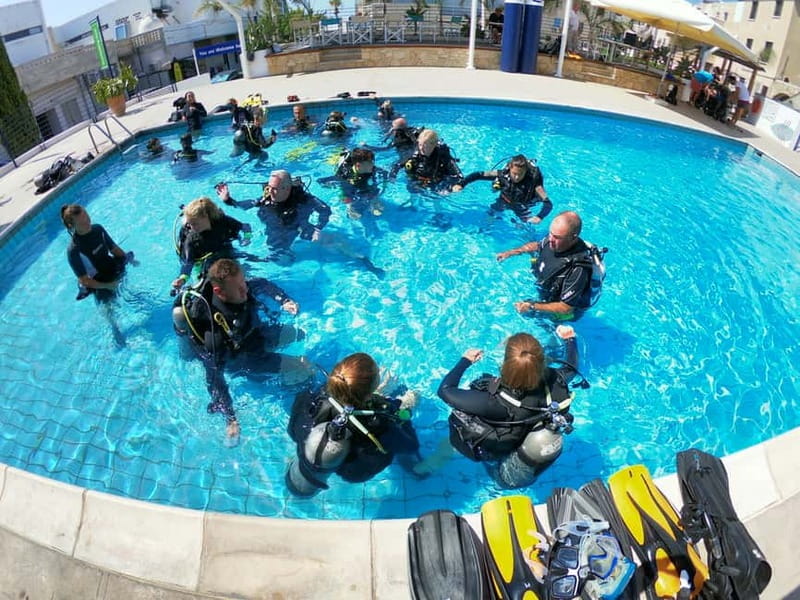
The pool is the smart middle step. You take your first breath underwater there and practise with the same equipment used in the open-water session. You also swim into the deep end of the training pool to work on ear equalisation and moving in full gear.
For many people, this is where the activity changes from strange to manageable. Breathing underwater does not feel natural at first, and the mask can make some participants uneasy. The pool gives you room to pause and ask for help before the sea adds waves, salt water, and a less familiar setting.
This is also where the instructors can see how each person handles the equipment. One person may feel fine with the regulator but struggle with the mask. Another may worry about depth or open water. The small-group format helps the team respond to those differences instead of pushing everyone at the same speed.
The practical value of this preparation came through in several sessions. A nervous participant who was uncomfortable with the mask and unusual breathing was able to continue after patient support. Another person was worried about the open sea but completed the full session after the instructor took time to settle her. That is exactly the sort of help you want from a first-time scuba lesson.
Still, the pool is not a shortcut around the physical demands. You need to be comfortable swimming. If you cannot swim, you will not be allowed to take part.
Walking to the sea and descending at 5 metres
After the lesson, the Roman Wall site is only a short walk away. That is a useful detail if you dislike long transfers in wet gear or want to keep the day simple. The session is a shore-based entry, not a boat trip.
The open-water portion lasts about an hour. You descend to as much as 5 metres under the direct guidance of the instructor. Expect the emphasis to remain on basic control and safety, with time to look around the Roman harbour remains.
The shallow depth is a major advantage for a first attempt. You have enough room to feel that you are truly underwater, but you are not being sent into a demanding environment. Your instructor remains close, explains what to do, and helps you manage the equipment as you go.
The site can offer more than a standard training area. You might see amphorae, old anchors, Roman walls, and other underwater traces connected with the ancient harbour. In summer, green turtles are possible. The experience should not be booked on the promise of a turtle, though. The historic underwater setting is the reliable attraction.
A second photo stop follows the underwater session, with a chance to view or consider purchasing images and video. Some sessions include a short presentation of the photographs afterward. This can be a nice record of your first scuba experience, but remember that it costs extra.
Another way to get in the water in Cyprus:
- Private Discovery Dive + Photos & Videos
★ 5.0 · 577 reviews - Try a Scuba Diving Experience
★ 5.0 · 400 reviews - Private Diving at Zenobia Wreck in Larnaka
★ 5.0 · 369 reviews - SCUBA DIVING first time experience
★ 5.0 · 216 reviews
The final class and a quiet finish
Back at Cydive, you have a short final class of about 15 minutes, followed by tea, coffee, and fruit. This closing section gives you a chance to ask questions and think about what comes next.
If the session sparks an interest in scuba, the team can explain routes toward full PADI certification. That follow-up matters because this activity is an introduction, not a licence. You learn basic skills and complete one supervised open-water session, but you do not leave as a certified scuba diver.
Several people have gone on to consider or book a full PADI course after enjoying the instruction. That makes Cydive a sensible choice if you are testing the water before committing to a longer course.
The refreshments are a small but welcome touch. Three hours in a wetsuit and equipment can be tiring, and a drink with fruit gives the morning a relaxed ending. It also leaves room to talk with the instructor while everything is still fresh.
What $106 includes, and where the value lies
At $106 per person, this is not the cheapest way to spend three hours in Paphos. The price makes more sense when you count what is included: scuba equipment, wetsuit, boots, the PADI Discover Scuba Diving eLearning product, instruction, pool training, the open-water session, water, tea, coffee, and fresh fruit.
You are paying for instruction and supervision as much as for underwater sightseeing. The pool lesson is important because it reduces the chance that your first open-water attempt will feel rushed or confusing. The small group, capped at eight, also gives the instructor a better chance to help you personally.
The main extra cost is underwater photography. You may purchase photos or videos after the session, but they are not included. Towels and sunscreen are also your responsibility. Bring both, along with swimwear and a hair tie.
I would call the price reasonable for someone who wants a properly taught first experience rather than a quick swim with basic equipment. It is less appealing if you mainly want a cheap look beneath the surface or already hold a scuba qualification.
Who should book this Paphos session
This suits first-time scuba participants aged 10 and above who are comfortable swimmers and curious about what lies below the harbour. It works particularly well for couples, families with older children, and people who feel nervous about trying scuba but want patient instruction.
The family age range can be broad. One session included participants aged 11 to 37, with the instructors adjusting their support for different abilities. That does not mean every child will be equally comfortable, but it shows why the small-group teaching format helps.
I would also recommend it to anyone considering a full PADI course. You can test how you feel about the mask, regulator, equipment, and underwater breathing before paying for a longer programme.
This is not suitable for pregnant women, people with heart or respiratory conditions, or people with epilepsy. You must complete a medical questionnaire before taking part. If you are congested with a cold, rescheduling is sensible because blocked ears can make equalising difficult.
Do not schedule the activity on the same day as a flight. You need to wait at least 12 to 24 hours after scuba before flying. Weather can also force a change of date.
Finding Cydive in Paphos Harbour
Cydive is near the harbour, but the entrance can be easier to find with clear directions. If you are driving, head toward Papantoniou Supermarket in the harbour area. Turn onto the small road beside the supermarket. Cydive is on the right, with parking to the left.
By bus, get off at Paphos Harbour, including route 615 from Coral Bay. Cross toward the bakery and ECOSI ice cream shop, then pass through the stone archway. The centre is on the left after the arch.
If you are walking beside the sea, head toward the harbour until you reach steps with a metal railing. Cross toward the restaurant side and use the alley beside The Captains View. Cydive is at the end.
Allow enough time to arrive without rushing. You will need to complete paperwork and get ready before the briefing.
What to bring and what to leave behind
Bring swimwear, a towel, sunscreen, and a hair tie. The centre supplies the wetsuit, boots, and other scuba equipment, so you do not need to pack specialist gear.
Cameras and waterproof cameras are not allowed during the activity. Do not bring alcohol or drugs, and smoking indoors is prohibited. Feeding animals is also not allowed.
The sunscreen is for before or after the session, not for handling marine life. The focus is on safe, responsible contact with the underwater environment.
Booking flexibility and language
You can cancel up to 24 hours in advance for a full refund, and the reserve-now, pay-later option can help if your Paphos plans are still shifting. Check the available start times because the activity lasts three hours.
Instruction is offered in English and Greek. The group limit is eight people, which is small enough for individual attention without making the experience feel like a private lesson.
If weather conditions are poor, the session may need to be rescheduled. That is a normal limitation of a shore-based sea activity, not a flaw in the format.
Should you book the Roman harbour scuba session?
Book it if you want a well-supported first scuba experience with real underwater sights, rather than a quick introduction in a pool alone. The Roman Wall site, 5-metre depth, short walk from the centre, and patient instructors give the activity a strong mix of history, training, and adventure.
I would be especially comfortable recommending it to nervous beginners. The instructors have a clear record of helping people who struggle with breathing, masks, depth, or the change from pool to sea. You still need to be a capable swimmer and medically eligible, and you should finish the eLearning before arrival.
Skip it if you cannot swim, have one of the listed medical conditions, need to fly immediately afterward, or want a longer and more advanced scuba outing. For everyone else, $106 buys a carefully structured three-hour introduction and a chance to see Paphos from a completely different angle.
FAQ
How deep is the first open-water scuba session?
The session reaches a maximum depth of 5 metres. It takes place at the Roman Wall training site near Paphos Harbour.
Is scuba equipment provided?
Yes. Scuba equipment, a wetsuit, and boots are included in the price.
Do I need to complete anything before the activity?
Yes. You receive access to the PADI Discover Scuba Diving eLearning product after booking, and you must complete it before the activity date.
Can non-swimmers take part?
No. Participants must be comfortable swimmers. People who cannot swim cannot join the activity.
What medical restrictions apply?
You cannot participate if you are pregnant or have epilepsy, heart problems, or respiratory conditions. Everyone must complete a medical questionnaire before the session.
Are underwater photos and videos included?
No. Underwater photos and videos are not included. They may be available to purchase separately after the session.
How long should I wait before flying?
You should wait at least 12 to 24 hours after scuba before flying on a plane.
More half-day trips in Cyprus
- Half-Day White Shark Cage Diving from Gansbaai
★ 4.5 · 310 reviews - From Dubai: Fujairah Half-Day Scuba Dive and Snorkeling
★ 4.7 · 186 reviews - Half-Day Diving in Sal
★ 5.0 · 135 reviews - Half-Day Small-Group 2-Tank Scuba Dive in Key Largo (CERTIFIED DIVERS ONLY)
★ 5.0 · 125 reviews
Newest dives added in Cyprus
- Protaras: Discover Scuba Diving (For Beginners)★ 5.0 · 7 reviews
- First Time Scuba Dive Adventure, Makronissos, Ayia Napa★ 5.0 · 12 reviews
- Beginners Discover Scuba Diving By Boat, Best Spot In Cyprus★ 5.0 · 26 reviews
- Musan Underwater Park with private Guide- no certification needed★ 5.0 · 13 reviews
- Scuba Diving – Tunnels & Caves – Cape Greco – private guided★ 5.0 · 25 reviews
- Discover Scuba Diving★ 5.0 · 43 reviews
- Ayia Napa: Musan Underwater Museum Scuba Dive★ 5.0 · 51 reviews
- Local Guided Dives (for certified/licensed divers)★ 5.0 · 115 reviews
Discover Scuba Diving, compared.
2 Days Discover Scuba Diving in Nusa Lembongan – Scuba Initiation
Read our review →
From Sharm: Ras Muhammed & White Island By Boat & intro Dive
Read our review →Browse the lists this dive appears in