
Reviewed · SCUBA DIVING FOR BEGINNERS
Two Tanks Scuba Diving for Beginners in Cancun
Cancun’s best underwater introduction pairs two very different sites: the statues of MUSA Underwater Museum and the sea life of Manchones Reef. Before you board, you learn basic skills in a pool, which gives first-timers a useful chance to settle their breathing and get comfortable with the equipment.
I like the small groups, capped at eight, and the patient instruction from guides such as Marin and Lorena. I also like that a single morning includes training plus two tank sessions, with wetsuit and standard equipment supplied. The main drawback is that you need to swim, meet strict health requirements, and cope with a boat ride that can be rough.
Key points at a glance
- Two different underwater settings: See MUSA’s submerged sculptures first, then look for marine life at Manchones Reef.
- Pool practice before open water: You work on essential skills with an instructor before leaving the dock.
- Small groups: The maximum is eight people, allowing closer guidance than a large boat operation.
- Patient named instructors: Marin, Lorena, and Carolina are frequently involved in instruction, equipment fitting, and support.
- Plan around your flight: You must wait 18 to 24 hours after the activity before flying.
- Bring the right essentials: Pack identification, swimsuit, towel, personal items, and motion-sickness medicine if needed.
From pool practice to Cancun’s underwater museum
This is a beginner-friendly introduction to scuba, but it is not a casual boat ride with a quick explanation at the dock. Your morning begins at 8:00 a.m. at Hotel Sotavento in Cancun’s Hotel Zone, where you complete a health questionnaire and get ready for instruction.
The theory session covers the basic equipment and underwater skills you need for the day. You then practice in a pool with a qualified instructor. This part matters. Breathing through a regulator, clearing a mask, and managing your body in the water can feel strange at first, especially if you are nervous about the ocean.
The instructors use humor, clear explanations, and repeated checks to help you relax. Marin is noted for a calm, funny approach, while Lorena is especially careful with step-by-step teaching. Carolina helps with check-in and equipment fitting. You are encouraged to ask questions before heading out, which is exactly what a first scuba experience needs.
If you panic or struggle in the pool, say so. One useful feature of this format is that the instructor can coach you before you reach open water. You do not need certification for this experience, but you do need to complete the pool skills safely. If you cannot perform the skills, you cannot continue, and there is no refund for that reason.
The boat leaves around 9:30 a.m. The schedule puts you back at the same dock near 1:00 p.m., so you can usually keep the rest of the afternoon free. Still, allow extra time after the stated return if weather or sea conditions slow the boat.
More Scuba Diving for Beginners in Mexico
- Diving in the Mexican Caribbean for Beginners | 2 Tanks 2 Dives | All Inclusive
★ 5.0 · 431 reviews - Beginner Scuba Diving in Cabo San Lucas
★ 5.0 · 247 reviews - Scuba Diving Under Water Museum and Reef for beginners
★ 5.0 · 189 reviews
MUSA: statues beneath the surface
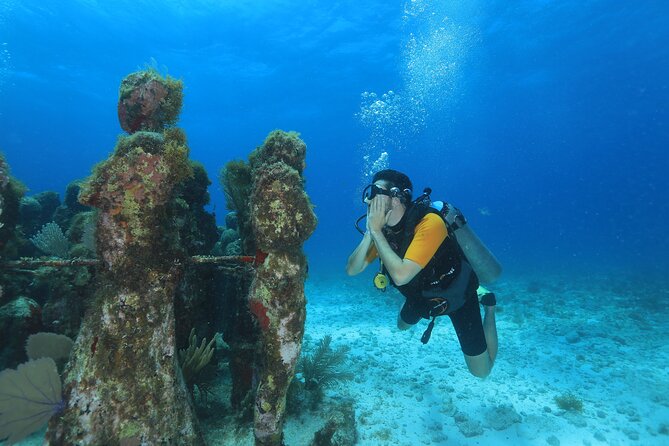
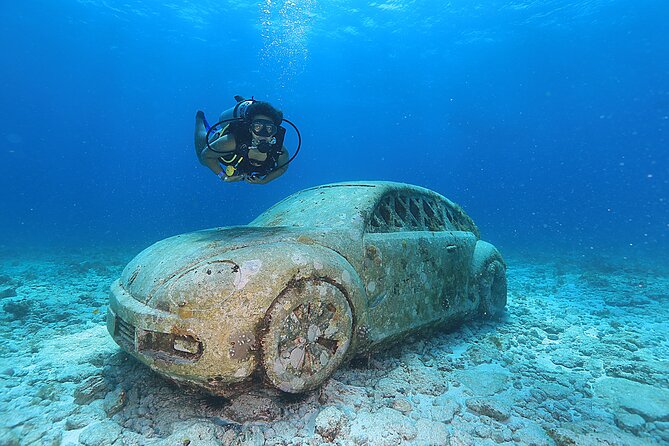
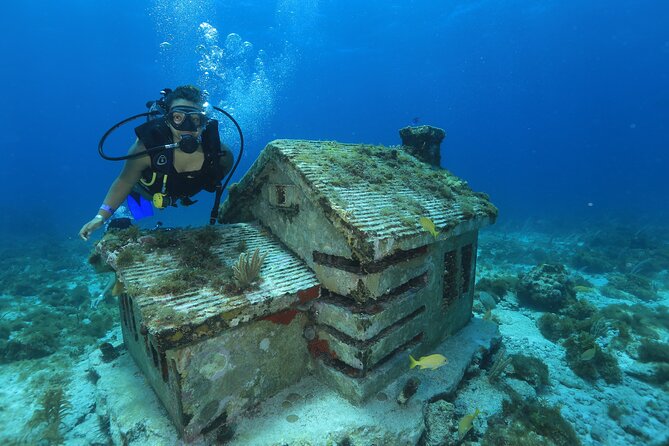
The first tank takes you to MUSA, the Museo Subacuático de Arte. This underwater museum places large human figures and other sculptures on the seafloor, where they have become part of the marine setting.
MUSA gives you something to focus on while you get used to being underwater. The sculptures are easy to recognize, and your guide can point out details as you move through the site. It is a cultural attraction, but it also raises questions about how art interacts with the sea and how marine growth changes man-made objects over time.
For some people, MUSA will be the highlight. For others, it is an unusual opening act before the reef. The experience depends on visibility, current, crowding, and your comfort level. One guide may also adjust the route to find less crowded areas, which can make the visit feel less like a simple procession past statues.
The first underwater session is also where your pool practice becomes real. You are learning to control your breathing, watch your depth, follow hand signals, and stay close to your instructor while looking at the sculptures. That combination can make the first tank feel demanding, even when the guide is calm and attentive.
Manchones Reef brings the marine life
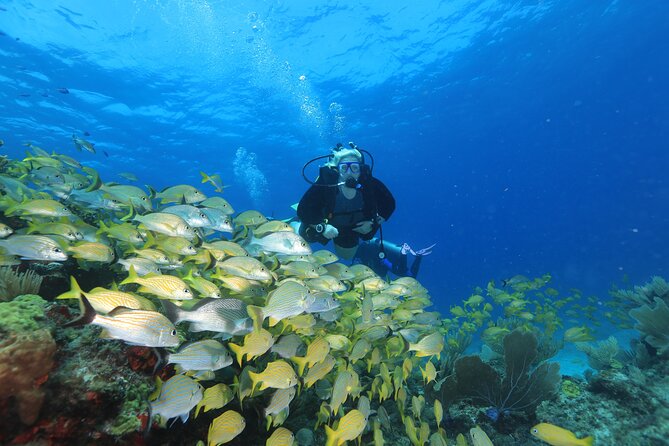
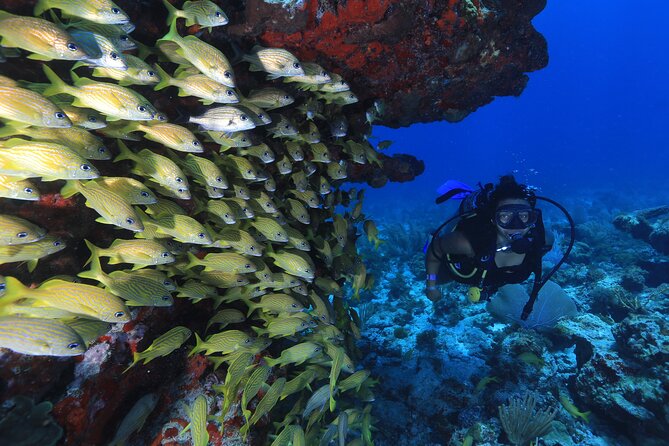
The second tank visits Manchones Reef, and this is where the natural side of the excursion takes over. The reef setting can include schools of tropical fish, lobsters, eels, rays, turtles, puffer fish, octopus, and other creatures. No one can promise a particular sighting, but the guides know where to look and use hand signals to direct your attention.
The difference between the two sites is one of the tour’s strongest features. MUSA gives you structure and visual landmarks. Manchones asks you to slow down and notice movement in the coral, beneath rocks, and along the seafloor.
A guide may use a flashlight to help spot small creatures in shaded spaces. That sort of help is valuable for a beginner, because you might swim right past an eel, lobster, or small animal without realizing it is there. The instructors also keep checking on your comfort, which matters when you are balancing breathing, buoyancy, and the view in front of you.
Conditions can change the feel of the second tank. Rough seas, wind, and recent storms may make the boat ride uncomfortable, even if the underwater conditions are good. One account describes a particularly rocky ride and seasickness despite taking medicine. The crew helped passengers stay seated and get ready, but motion-sensitive people should take the boat seriously.
Why the small group size matters
The maximum group size is eight, though the actual guide-to-participant ratio can be even better. A small group means less time waiting for someone who is struggling with equipment and more opportunity for the instructor to notice body language underwater.
That personal attention is especially helpful if you are afraid of the ocean, sharks, or losing control. Several instructors, including Marin and Lorena, are praised for staying close, offering reassurance, and adjusting their pace for nervous first-timers. This is not a certification course, but it gives you a careful first taste of scuba rather than rushing you straight from the dock into the sea.
You still have responsibilities. Stay near the group, watch the guide’s signals, and tell the instructor if you feel uneasy. One participant felt the guide could have watched the group’s spacing more closely, a useful reminder that even a well-run small group is not a private session every second.
The small boat also has a practical advantage. You avoid the scale of a large multi-group operation, where several sets of divers may enter the water at once. The tradeoff is that a smaller boat may feel more exposed to wave movement. If you are prone to seasickness, take an anti-nausea pill one or two hours before boarding, as suggested for this activity.
More Two-Tank Boat Dives in Mexico
- 2 Tank Dive – Certified Divers (Santa Maria Bay & Chileno Bay)
★ 5.0 · 162 reviews - 2 Tank Morning Dive: Scuba Diving in Cozumel
★ 5.0 · 148 reviews - Two tanks local diving for certified divers, SCUBA gear included
★ 5.0 · 122 reviews - 2 Tank Dive (for certified divers)
★ 5.0 · 120 reviews
Equipment, photos, and the real price
The price is $169 per person. That includes the theory lesson, pool practice, two tank sessions, a wetsuit, BCD, regulator, mask, and fins. Transportation from your hotel is not included, so you need to reach Hotel Sotavento on your own.
For someone who wants to try scuba without committing to a full certification course, the price can be reasonable. You are paying for instruction, equipment, a boat trip, two underwater sites, and a small-group format in one morning. The value is strongest if you want both MUSA and Manchones Reef rather than a short single-site session.
Photos and video cost extra. I would treat that as an optional add-on, not a hidden requirement. Some people bring a GoPro or Insta360, but using a camera while learning new breathing and buoyancy skills can be distracting. An instructor-operated camera may capture better images because the guide can focus on framing you and finding marine life.
Several participants were glad they bought the photo package at the end, especially when their own camera malfunctioned or was awkward to handle. If you want a keepsake, ask about the package before the boat leaves and confirm the extra cost.
What to bring, and what not to pack
Bring your identification, swimsuit, towel, and any personal-care items you need. Keep valuables and loose belongings protected, since water from spray and wet equipment can make storage a concern. A waterproof sack is useful for anything that must stay dry.
Sunscreen and sunblock are not allowed because of coral protection rules. Plan your sun protection around that restriction rather than applying lotion just before departure. The supplied information does not specify an alternative product, so ask the operator what is permitted if you need extra protection.
Wear practical swim clothing and arrive ready for a morning on the water. You need to know how to swim, and you should have a moderate level of physical fitness. This is not a sightseeing cruise where you can simply sit out the active portions.
The age range is 10 to 65. Children must meet the same swimming and safety requirements as adults. The medical questionnaire is not a formality. People with asthma, heart or brain conditions, high blood pressure, lung lesions, an organ transplant, diabetes, epilepsy, or surgery within the past year cannot take part.
You also need to plan around air travel. Wait 18 to 24 hours after scuba before boarding an airplane. That makes this a poor choice on the final morning of a Cancun trip, and it may require you to schedule the activity early enough in your holiday.
Weather, seasickness, and timing
The experience depends on good weather. If poor conditions cancel the outing, you can choose another date or receive a full refund. The same applies if the minimum number of participants is not reached.
Even on a day when the trip goes ahead, the ride may be choppy. Take motion-sickness medicine one or two hours before boarding if you need it, and avoid staring down at the water during a rough crossing. The crew can help you get seated and prepared, but prevention is better than trying to recover once the boat is moving.
The early start is practical. You check in at 8:00 a.m., complete the paperwork and lesson, leave around 9:30 a.m., and return near 1:00 p.m. That schedule gives you a full afternoon, though you should avoid booking another demanding activity immediately afterward in case the sea leaves you tired.
You also need to arrange your own transport to Hotel Sotavento. The meeting point is on Boulevard Kukulcan in the Hotel Zone and is near public transportation. Check your route in advance, since late arrival could cut into the pool lesson or boat departure.
Who will get the most from this experience?
I would choose this for a first-time scuba participant who wants more than a shallow introduction. The pool practice gives you time to learn, and the two locations provide a useful contrast between art and reef life.
It also suits an experienced diver who has not been underwater for years and wants a refresher. The instruction can help you rebuild comfort before the ocean session, while the small group may feel more personal than a large commercial boat.
Families can consider it if everyone meets the age, health, swimming, and fitness rules. The experience has worked well for groups with children and for solo participants, but a nervous child should be ready to follow instructions and perform the pool skills.
I would be more cautious if you dislike boats, struggle with motion sickness, cannot swim confidently, or have a flight scheduled the same day or next morning. You should also skip it if any medical restriction applies rather than hoping the questionnaire will be overlooked.
Should you book it?
Book this A’HA Scuba Diving experience if you want patient instruction, a small group, and two distinct underwater settings without taking a certification course. The strongest reasons are the careful pool preparation, the attentive guides, and the chance to see both MUSA and Manchones Reef in one morning.
Think twice if you want a relaxed surface excursion, need hotel pickup, or are uncomfortable with a small boat. Schedule it early in your stay, bring a towel and identification, prepare for possible seasickness, and leave at least 18 to 24 hours before your flight. For a first scuba experience in Cancun, that planning turns a potentially nerve-racking morning into a much better chance of enjoying what is below the surface.
FAQ
Do I need scuba certification to join?
No. The activity teaches basic scuba theory and skills in a pool before the two tank sessions. You must still complete the required water skills safely.
How long does the experience last?
It lasts about five hours. Check-in begins at 8:00 a.m., the boat leaves around 9:30 a.m., and you return to the same dock near 1:00 p.m.
Where do I meet the group?
The meeting point is Hotel Sotavento Cancun, Km. 4, Boulevard Kukulcan, in Cancun’s Hotel Zone. You arrange your own transportation to the meeting point.
What sites will I visit?
The first tank is at MUSA Underwater Museum. The second is at Manchones Reef.
What equipment is included?
The tour includes a BCD, regulator, mask, fins, and wetsuit, along with the basic theory and pool lessons.
Can I fly after the activity?
You should wait 18 to 24 hours after scuba before boarding an airplane.
What happens if the weather cancels the tour?
You can choose another date or receive a full refund if poor weather causes the cancellation. The same options apply if the minimum number of participants is not reached.
Newest dives added in Mexico
- PADI Open Water Diver Course in the Riviera Maya★ 5.0 · 47 reviews
- MUSA Museum and Colorful Reef 2 Tank Dive-Certified Divers★ 5.0 · 57 reviews
- PADI Discover Scuba Diving for divers without certification★ 5.0 · 77 reviews
- Scuba Diving Adventure WITHOUT CERTIFICATION! Try it today!★ 5.0 · 57 reviews
- Cozumel Dive Package – Certified Divers from the Riviera Maya (4 dives)★ 4.5 · 51 reviews
- Cancun: MUSA Diving for certified divers morning dive trip★ 4.9 · 7 reviews
- 2-Tank Morning or Afternoon Dives in Playa del Carmen certified Divers Only★ 4.5 · 33 reviews
- Cenotes 2-Tank Dive in Playa del Carmen/for certified divers only★ 4.0 · 13 reviews
Scuba Diving for Beginners, compared.
First-Time Scuba Diving in Honolulu + Free Videos
Read our review →
Beginner Scuba Diving with Turtles and Videos, San Juan
Read our review →
Intro Diving 2 Stops For Beginners with Pick-up and Lunch – Hurghada
Read our review →
Intro Diving Beginner and Discover Red Sea Underwater
Read our review →
Beginner’s Dive at a Spot with Turtle Sightings
Read our review →
Scuba Diving Experience in Caldera for Beginners
Read our review →Browse the lists this dive appears in