
Reviewed · NIGHT DIVES
Aruba 1-Tank guided UV Night Dive for certified divers with rental equipment
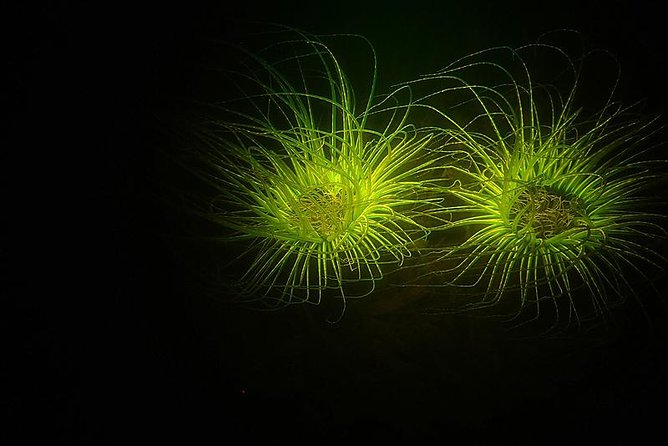
The most unusual thing about this UV night outing is how much the reef changes under a special wavelength of light. Some corals and sea creatures remain dark, while others glow in sharp fluorescent colors. Tiny coral recruits, almost impossible to spot in daylight, can appear as bright dots across the reef.
I like the small four-person limit, which should make it easier to stay close to the guide. I also like that the visor and light are supplied, so you do not need to assemble your own fluorescent kit. The main concern is the shore entry at The Hole in the Wall, where current can make the outing less comfortable than a calm boat trip.
Key points to know before booking
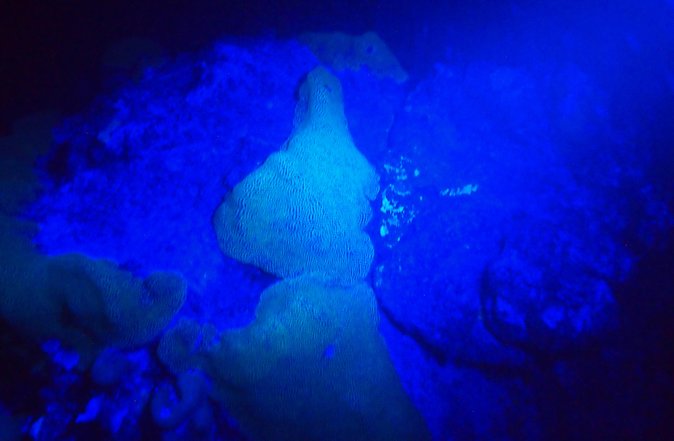
- The reef glows in patches: Fluorescence affects some animals and corals, not everything you see.
- The Hole in the Wall is a shore site: You will enter from land rather than from a boat.
- A visor and special light are included: The equipment lets you see colors that ordinary night lighting will miss.
- The group is capped at four people: This is a more personal format than a large group outing.
- You must be certified: The minimum age is 12, and this is not for beginners without certification.
- Plan around the no-fly rule: You must wait at least 24 hours after the outing before flying.
Why fluorescent night exploration feels so different
A regular night outing already changes the reef. The darkness narrows your view, your light picks out only one small area at a time, and familiar coral formations can look completely new.
The UV version adds another layer. Certain reef creatures respond to a particular wavelength by giving off visible color. The reaction is passive, so the animals are not spending energy to create a light show. Scientists still do not fully understand why the trait developed, which gives the sight an unusual scientific edge as well as visual appeal.
I would set your expectations correctly. This is not a reef where every surface glows like a display window. Fluorescence is selective. Some corals and animals may shine intensely, while others look much as they would during an ordinary night outing.
That uneven quality is part of the charm. You slowly search the reef, waiting for a small patch of color to appear. A coral head that looked plain a moment earlier can reveal green, orange, or another bright tone when the light reaches it. The reward comes from noticing, not from constant spectacle.
The visor matters because it helps filter the light and makes the fluorescent response easier to see. Without the right setup, you could miss the effect or see it less clearly. Here, the special light and visor are included in the package.
More Night Dives in Aruba
- Aruba Guided Night Dive Adventure: Shallow Reefs or Shipwrecks
★ 5.0 · 12 reviews - Certified Diver: 2-Tank Night Dive
★ 5.0 · 61 reviews - One Tank Manta Night Dive and Snorkel
★ 5.0 · 56 reviews
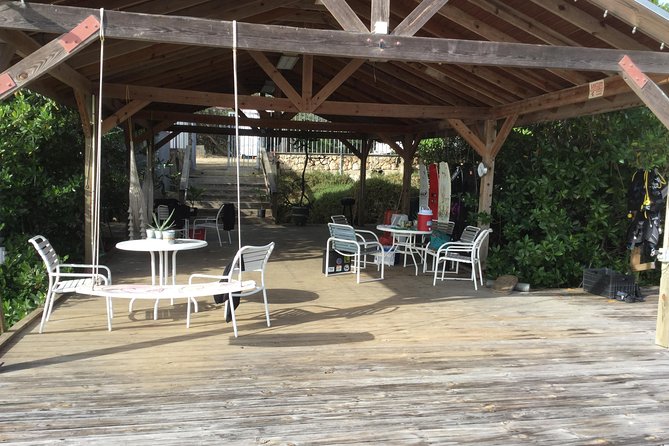
Meeting at Pure Diving Aruba at 5:00 pm
The outing begins at Pure Diving Aruba, at Bucutiweg in Oranjestad. The stated start time is 5:00 pm, and the full activity takes about two hours.
That late-afternoon start gives the group time to prepare before full darkness. You are not heading straight into the water at midday and waiting for night to arrive. The timing is built around an evening shore session, so plan on returning to the same meeting point after the outing.
Parking is available on the premises. That is a small but useful detail, especially when you are carrying personal items and equipment. The activity uses a mobile ticket, and confirmation is provided when you book.
The group limit of four is one of the better practical features. A tiny group makes it easier for the guide to keep everyone together, explain what you are seeing, and adjust the pace. It also reduces the chance that a large cluster of lights will wash out the delicate fluorescent effect.
No guide name is provided, so you should not book this expecting a particular instructor. The guide is important here, though. A good leader will help you identify what is glowing, keep the group organized, and manage the shore entry safely.
Preparing for The Hole in the Wall shore entry
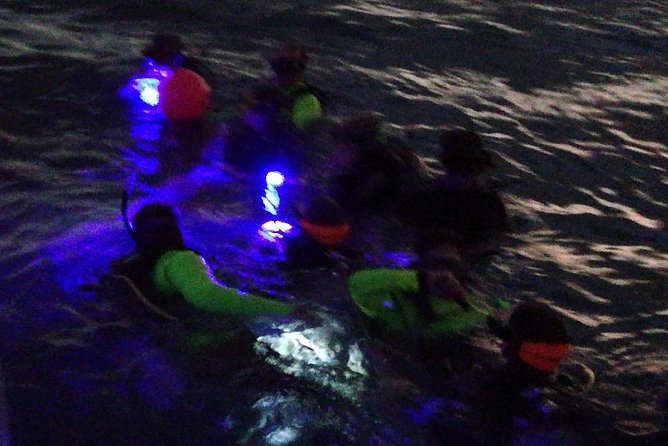
The actual site is The Hole in the Wall, and the outing is conducted from shore. That distinction deserves attention because a shore entry can feel very different from stepping off a boat onto open water.
You will need to move from land into the sea with your equipment before reaching the reef area. Conditions can vary, and current is the main factor to consider. A rough current can make the outing tiring or reduce the time you spend calmly inspecting the reef.
This is the clearest weakness of the arrangement. A boat-based morning trip may offer a more controlled way to reach a site, while this one depends on the conditions at the shore. The provider cannot control the current, so a calm forecast does not guarantee a perfectly still entry.
If you are comfortable with shore-based underwater activities and certified in your sport, this may be a reasonable tradeoff for the unusual setting. If you strongly prefer easy entries and predictable water movement, ask about a boat option before booking. The operator offers two-tank morning outings from a boat, but that is a different product.
The location also gives the activity a more direct connection to Aruba’s coast. You are not simply boarding a boat, riding out, and returning. You prepare at the meeting point, make the shore entry, explore the site, and finish back where you started.
What you will see under the special light
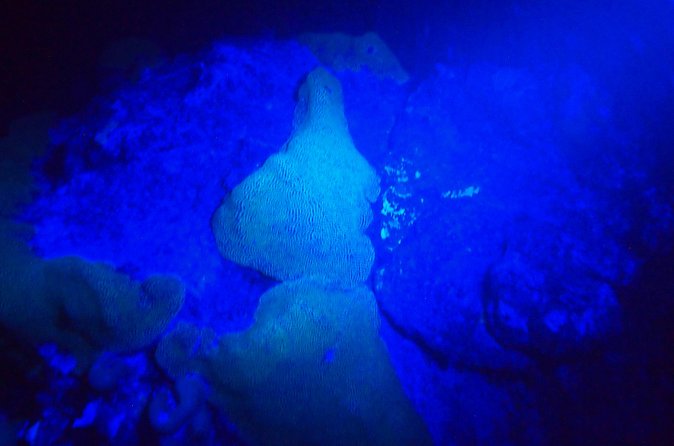
The main attraction is not a list of named animals. It is the change in appearance caused by the light.
Some aquatic animals and corals fluoresce. Others do not. Your guide may point out the difference between ordinary color and a fluorescent response, helping you understand why one small area glows while the next remains dark.
Coral recruits are especially interesting. These are coral polyps that have attached to the reef surface and begun forming a new colony. During daylight, they can be so tiny that you would likely pass over them. Under fluorescent light, they may show up as small bright dots.
That makes the outing more than a colorful nighttime display. You are also looking at early coral growth, the first stage of a new colony. The same feature is useful to coral conservationists, who use fluorescence to help locate recruits on reefs.
I like this detail because it gives you something specific to look for. Instead of only scanning for large animals, you can search for small points of light and think about what they represent. The scale changes from big reef scenery to tiny signs of new growth.
You should not expect the guide to identify every creature or guarantee a particular animal. The information supplied promises special aquatic animals and corals, but it does not name species or promise sightings. Your strongest reason to book is the fluorescent effect itself, with wildlife as an added possibility.
More Dives for Certified Divers in Aruba
- Aruba 2-Tank Dive Excursion for Certified Divers
★ 4.5 · 230 reviews - Small-Group Aruba Scuba Diving for Non-Certified Divers
★ 5.0 · 194 reviews - Aruba Certified Scuba Diving
★ 5.0 · 182 reviews - Aruba PADI Scuba Diving Program Non Certified Divers
★ 5.0 · 99 reviews
How the two-hour schedule works
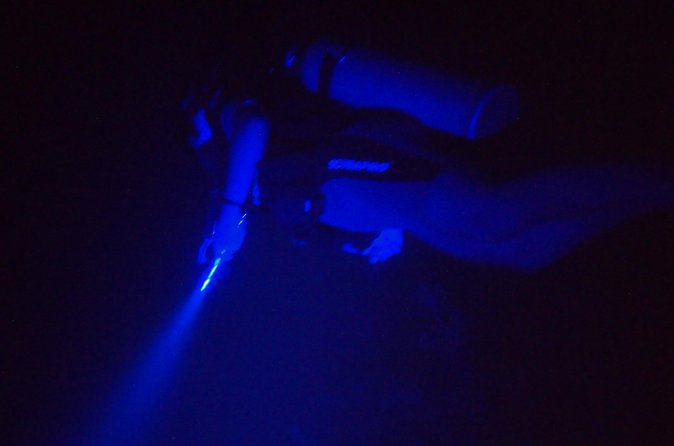
The listed duration is about two hours. That includes the meeting and preparation period, the shore entry, the underwater portion, and the return to the meeting point.
Because the activity starts at 5:00 pm, the outing takes place during the shift from daylight into evening. The precise amount of time in the water is not specified, so do not assume that the entire two hours will be spent underwater.
A small group can help the schedule run smoothly. With no more than four participants, less time should be spent waiting for a large group to assemble or catch up. Still, shore conditions may affect how quickly the group enters and how long it can comfortably remain at the site.
The guide’s role is particularly important after darkness sets in. You will be using a light, working with a visor, and watching your position relative to the group. Stay close, follow instructions, and avoid treating the glowing reef as something to explore independently.
The activity ends back at the starting point. That makes it easier to plan your evening than an outing with a separate return location. Give yourself a little flexibility afterward rather than scheduling a meal at an exact minute.
Equipment, certification, and age rules
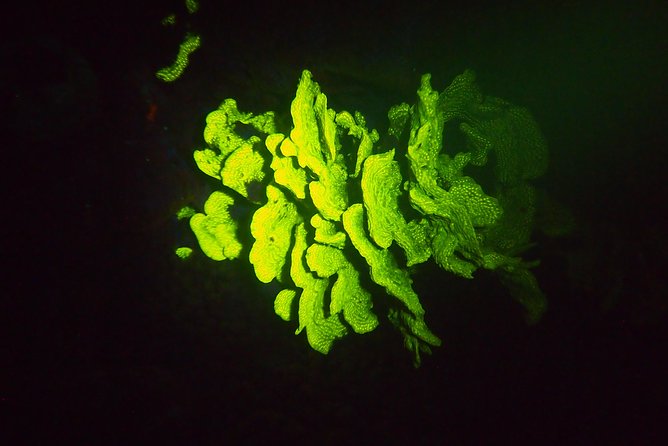
The package includes the dive light and fluorescent visor. Rental equipment is also part of the advertised experience, which is helpful if you are visiting Aruba without your own kit.
The supplied light is not just a standard torch for finding your way. It is selected to produce the wavelength that brings out fluorescence. The visor helps you see the effect more clearly through your mask.
You must be a certified diver. The minimum age is 12, and most people who meet the certification requirement can participate. The activity is not designed as a lesson or introductory session.
Bring realistic expectations about your own comfort level. Certification does not guarantee that a shore entry will feel easy, particularly if the current is rough. If you are out of practice, discuss your comfort level with the operator before setting off.
The equipment is practical, but it does not remove the need for good judgment. You still need to manage your air, stay with the group, and handle the conditions at The Hole in the Wall.
Is the $123 price good value?
The cost is $123 per person, before Aruba’s 7 percent local government tax. The value depends on what you want from a night outing.
For a certified diver who is curious about fluorescence, the price includes the key specialty items, rental equipment, a guide, and a small group capped at four people. You are paying for a focused evening session rather than a standard daytime reef trip.
The price is less compelling if you mainly want easy access to a famous reef or a broad range of large marine life. This is a one-tank shore outing, and the fluorescent effect is selective. You may see striking colors, but you may also spend time searching through dark areas where little responds to the light.
I would compare it with your alternatives. A boat-based morning outing may be better value if you want two tanks, less dependence on shore conditions, or a wider site choice. This UV option earns its price through the specialty equipment and unusual viewing method, not through a long itinerary.
The group size helps the value. Four people is a much more manageable number than a crowded group, especially at night. If personal instruction and close supervision matter to you, that feature may justify the cost.
The main drawback: current at a shore site
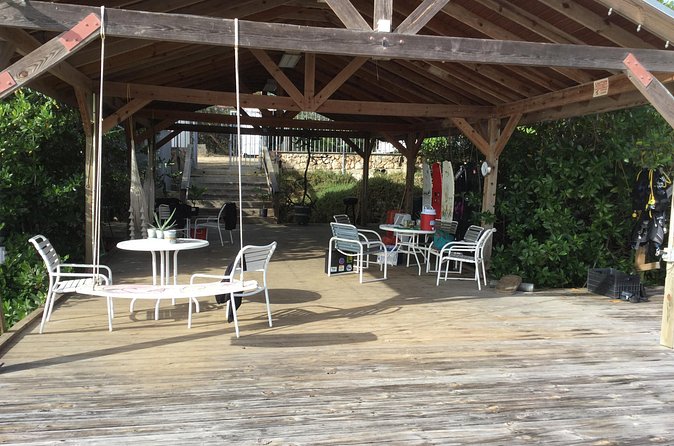
The most important warning is simple: conditions can make or break this activity.
The Hole in the Wall is a shore location, and current is not something the operator can control. A strong current may make the entry rough, reduce comfort, and take attention away from the fluorescent viewing.
This is not a minor footnote. If you imagined a slow, relaxed search across a perfectly still reef, the reality may not match that picture. You may need to work harder to hold position, and the underwater time may feel less peaceful.
The guide remains a major part of the outing’s quality. A strong guide can help you keep your bearings, identify the glowing areas, and manage a small group. But even excellent guidance cannot change the water conditions.
I would choose this only if you are comfortable with a shore-based certified outing and willing to accept some uncertainty. If the current is rough on the day, the experience may be more demanding than you hoped.
Who should book this Aruba night outing?
This is a good fit for a certified diver who has already seen ordinary reef scenery and wants something genuinely different. It also suits anyone interested in coral growth, marine biology, or the visual effect of special light on living organisms.
The four-person limit makes it appealing if you prefer a quieter, more personal format. The included visor and light are useful if you do not own fluorescent equipment.
It may suit you less if you want a beginner lesson, a guaranteed list of animals, or a boat-based entry. It is also a poor choice if your holiday schedule requires flying soon afterward, since you must wait at least 24 hours after the activity before flying.
At least 15 days of advance booking is typical, so reserve ahead if the date matters. The cancellation terms are reasonable: you can cancel at least 24 hours before the 5:00 pm start for a full refund. Changes or cancellations inside that window are not accepted for a refund.
Should you book it?
Book this if the idea of finding tiny glowing coral recruits and patches of fluorescent reef sounds more exciting than a conventional night session. The special light, supplied visor, small group, and scientific angle give the outing a clear identity.
Skip it if you mainly want the easiest possible water entry or a boat trip with two tanks. The current at The Hole in the Wall is the deciding factor, and the one-tank format offers less room for conditions to improve later in the day.
For the right certified diver, this is a compact and unusual way to see Aruba’s reef. Just treat the glowing colors as selective discoveries, not a guaranteed underwater light show.
FAQ
Where does the activity begin and end?
It begins at Pure Diving Aruba, Bucutiweg, Oranjestad, Aruba, and ends back at the same meeting point.
What time does the activity start?
The scheduled start time is 5:00 pm.
How long does the activity last?
The activity lasts approximately two hours.
Is the activity suitable for beginners?
No. It is only for certified divers.
What equipment is included?
A dive light and fluorescent visor are included. Rental equipment is also part of the advertised experience.
How soon can I fly after the activity?
You must wait at least 24 hours after the activity before flying.
More evening trips in Aruba
- Night Shore Diving Mangel Halto Aruba for Certified Divers
★ 5.0 · 6 reviews - 2 Days & 1 Night – 2 Dives in Lembongan/Penida (for certified divers)
★ 5.0 · 76 reviews - 3 Night Ningaloo Reef Snorkel and Dive Getaway from Coral Bay
★ 5.0 · 74 reviews - Tokyo Ikebukuro Evening Tour Dive into Japanese culture
★ 5.0 · 15 reviews
Newest dives added in Aruba
- Shore Dive Aruba for Certified Divers★ 4.5 · 33 reviews
- Private Dive + videographer/Photographer (Certified divers only)★ 5.0 · 11 reviews
- Private Dive at Shipwreck + Beautiful Reef Spot(Certified divers)★ 3.0 · 2 reviews
- Guided Padi Discover Scuba Diving for Non-Certified Divers★ 5.0 · 33 reviews
- Night Shore Diving Mangel Halto Aruba for Certified Divers★ 5.0 · 6 reviews
- Half-Day Aruba Intro Diving Course for Beginners★ 4.5 · 97 reviews
- Boat Dive Shipwreck/ Airplanes/ Reef /2 tanks★ 4.0 · 13 reviews
- Aruba Flyboarding & Jetovator Experience: Fly Like a Bird & Dive Like a Dolphin★ 4.5 · 64 reviews
Night Dives, compared.
Scuba Diving Kata Beach Night Dive for Certified Divers
Read our review →
Pro Dive Great Barrier Reef 3 Day/2 Night Dive Trip
Read our review →
Aruba Guided Night Dive Adventure: Shallow Reefs or Shipwrecks
Read our review →
Browse the lists this dive appears in